

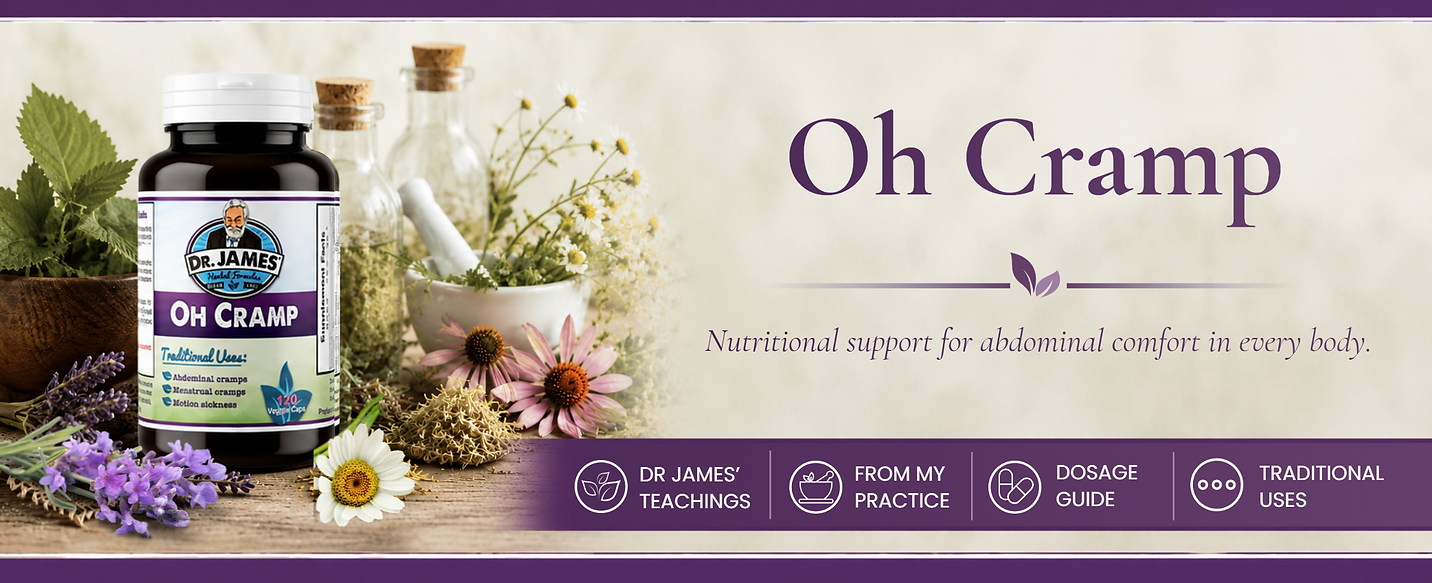

From Dr. James' Teachings
One afternoon, one of my daughters came to me. She told me that she was having terrible cramps and needed something for them. When she said this, I immediately became judgmental, reasoning that my daughter had this problem because she had not followed my earlier directions. The father in me would teach her a lesson, and the compassionate herbalist would be stuffed in a corner. Shame, shame on me!
Nevertheless, that's what I did. Knowing that ginger tea would help, but that it tastes really bad, that's what I told her to take. Grimacing, she said, "Oh, Daddy, that's nasty." My response of, "That's OK, it will help," was the last thing we discussed about this particular matter.
Later, I overheard a conversation she was having with her mother. She was no longer in any pain and was quite excited about what she had done. Obviously, my lesson of, "It's better to consistently take your herbs than it is to drink nasty herbal tea," had not been learned. When I asked her what she had done, she replied, "I took Oh Cramp!, and my cramps went away in just a few minutes."
Perplexed, I asked her why she took Oh Cramp! Her reply was, "I know that ginger tea is nasty, and I didn't want to drink it, so I looked through your formulas and took the one with the most ginger in it. When the capsules opened up in my stomach, I felt this warm feeling flow over my cramping stomach, and the pain went away."
In actuality, two lessons were learned that day. The father learned that he shouldn't be an herbalist, and the herbalist learned, "Don't let the father inside say anything." If I had had the same compassion, understanding, and listening ear, perhaps that calm, peaceful feeling that descends upon the physician in need of an answer would have inspired this question.
Although this experience involved menstrual cramps, I have found this formula to be valuable whenever abdominal cramping is the primary concern. Rather than addressing the underlying cause of the cramping, its purpose is to help relieve the discomfort while other formulas are used to support the body's long-term health and function.

From My Practice
Abdominal cramping can have many different causes, and one of the things I love about Oh Cramp! is its versatility. While many people associate it with menstrual cramps, I regularly recommend it for much more than that. I have found it helpful for digestive cramping, abdominal discomfort associated with distension, nausea, and even soreness or cramping of the abdominal muscles after overexertion. Whenever the discomfort is centered in the abdomen, this is a formula I keep in mind.
I have personally used Oh Cramp! for abdominal cramping that had nothing to do with my menstrual cycle, and I have been very pleased with the results. Rather than limiting this formula to one specific type of discomfort, I think of it as a versatile option whenever abdominal cramping is the primary concern.
Although this page focuses on abdominal cramping, that is only one of the many traditional uses of this formula. It has also been traditionally used for motion sickness, nausea, dizziness, circulatory support, and several other applications.

Dosage Guide
A personal note for my clients: If we've worked together recently, please follow the recommendations I gave you during your consultation. They were personalized to your individual health needs, goals, and circumstances and may differ from the general dosage suggestions provided here or on the bottle.
Support Needed
Maintenance
Mild
Moderate
Intensive
Common Amount
1 to 2 capsules as needed
1 to 2 capsules as needed
2 to 3 capsules as needed
2 to 3 capsules as needed
Don't be afraid to take enough to notice a difference. During particularly stressful times, it's perfectly reasonable to use Nerquilizer more frequently for a while, then gradually space the doses farther apart as your nervous system settles. Listen to your body. If you need a little extra support between your regular doses, take it. As things improve, you'll naturally find yourself needing it less often. Your needs may change from day to day, or even moment to moment.
The directions on the bottle provide a general recommendation. In my own practice, I view those amounts as a starting point, not a limit. During times of greater discomfort, I adjust the amount and frequency according to the level of support the body seems to need.

Traditional Use of the Contents
Ginger Root supports healthy digestion, promotes healthy circulation, provides comfort during nausea and abdominal cramping, and has been traditionally used for motion sickness and dizziness.
Cayenne Pepper supports healthy circulation and cardiovascular function, promotes warmth throughout the body, and has been traditionally used to support heat tolerance, dizziness, and healthy blood flow.
Peppermint Leaf supports digestive comfort, helps soothe abdominal discomfort, promotes relaxation of the digestive tract, and has also been traditionally used to support headache relief, nervous system function, and restful sleep.
Rosemary Leaf supports healthy circulation, digestive comfort, cognitive function, occasional pain relief, and overall wellness.